Operator Loop
Product-Operated Agentic SDLC for Growth Teams. Follow-up to Hypothesis Board.
Operator Loop is the short label for Product-Operated Agentic SDLC. Same thing.
In short
AI didn’t just cut the cost of code. It cut the cost of the whole execution stack. Once Product can use connected agents to produce design, spec, PRs, and evidence packages directly, the Product→Engineering handoff stops being the critical path. Engineering changes role: from default executor to control plane owner — agent skills, CI, flags, evals, triggers, rollback, architecture.
Product operates. Agents execute. Engineering owns the control plane. Telemetry decides.This is not AI-assisted engineering. It’s an inversion of who holds the wheel of the delivery loop.
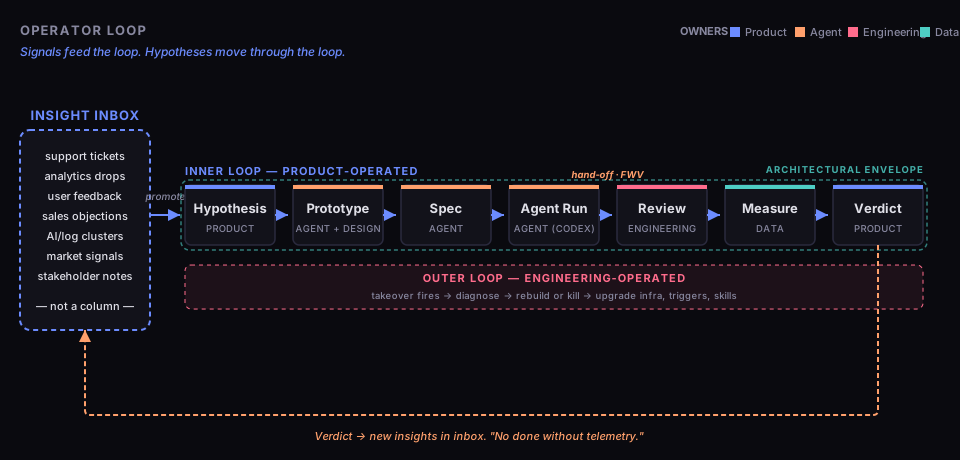
The first adoption zone is growth engineering: small, observable, reversible, feature-flagged changes.
Start where the loop is short: growth, onboarding, paywall, activation, retention, pricing, funnel, and AI prompt experiments.
TL;DR
- Unit of work stays a hypothesis with a falsification threshold.
- Default executor shifts: Product runs agents across the connected toolchain — tracker, design tool, repo, CI.
- Engineering doesn’t disappear. It becomes the control plane owner: agent skills, CI, flags, evals, triggers, rollback, architecture.
- Agent output is an evidence package, not “done.”
- Done is still a telemetry-backed verdict.
What “Product-Operated” actually means
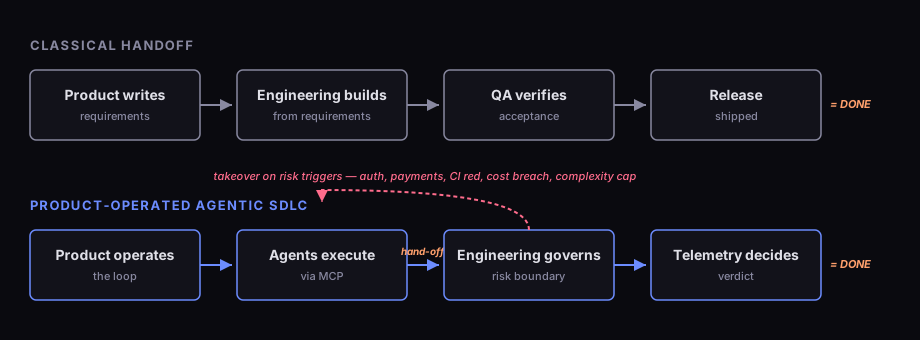
In the classical model:
Product writes requirements
→ Engineering builds
→ QA verifies
→ Release
Under Product-Operated Agentic SDLC:
Signals from Insight Inbox → Product states the hypothesis
→ Prototype → spec
→ Agent run produces PR, tests, telemetry plan
→ Review: engineering reviews, approves, or takes over if a trigger fires
→ Controlled rollout behind a flag, measurement begins
→ Telemetry delivers the verdict
Product doesn’t stop being Product. It doesn’t become an engineer. It gets operational control for low- and medium-risk delivery, and agents become its runtime.
Engineering stops being the default executor for every low-risk artifact. It becomes the owner of the control plane: agent skills, CI, flags, evals, triggers, rollback, architecture.
Review is always on. Takeover is conditional.
What we actually assembled
Not new physics. A sharper stack:
HYPEX: hypothesis → experiment → data → learning
RIGHT: infrastructure for experimentation
JPD: idea / insight / delivery tracking
Shape Up: shaping before build
Connected agents: Product can operate tools directly
The new shift:
Product no longer hands off intent.
Product operates the delivery loop.
Where this works first
Operator Loop is not a universal rule for all software delivery.
It works first where the feedback cycle is short and the change surface is observable: growth, onboarding, paywall, activation, lifecycle, pricing, funnel, prompt, and UX experiments. Features in this zone are visible on the product surface, not smeared across microservices and queues, and the work is mostly tuning: copy, placement, flow, threshold, prompt, not large new functionality.
Concrete examples:
- onboarding flow changes
- paywall and pricing experiments
- upgrade and activation nudges
- retention and lifecycle emails
- push notification copy
- AI assistant prompt variants
- funnel step changes
- landing page variants
- recommendation tuning
Poor first fits: enterprise-scale cross-service changes, quarterly release scope, deep refactors, platform migrations, and domains where the functional breakdown cannot be made explicit from product intent.
Operator Loop does not solve functional breakdown for large systems. It avoids that problem by starting with small, observable, growth-oriented changes. This is not a weakness. This is an honest wedge.
Start where Product can see the change, flag the change, measure the change, and kill the change.
Feasibility splits into two passes
Classical sequence: impact and feasibility analysis → spec → prototype. That order assumed prototyping was expensive.
Operator Loop splits feasibility into two passes.
Pre-flight, before Prototype: a lightweight, AI-assisted triage on the hypothesis itself — signal strength, reversibility, measurability, rough impact, obvious blockers. Used to decide whether the hypothesis is worth a cheap prototype at all. Cheap to do, cheap to skip.
Committed, after Prototype: the real feasibility pass on a live artifact that has now touched design, code, telemetry, cost, latency, and rollout. Only then does the team commit to a spec.
Feasibility does not move to the end. It splits. The first pass kills hypotheses that are not worth prototyping. The second pass kills prototypes that are not worth committing to.
The hard part is not code generation
The hard part is functional breakdown. Turning a product intention into the right change means identifying the services to touch, the domain rules to preserve, the architectural boundaries not to break, and the places where those three come into conflict. Reverse-engineering that from a large distributed codebase is unreliable. It is the hardest unsolved part of agent-driven delivery, not the code generation itself.
Operator Loop sidesteps breakdown as a first-adoption problem by narrowing the zone: changes small enough that the user-facing behavior is visible on the product surface, the rollout can go behind a flag, the first product signal can be measured in days, and a bad result can be killed. As agent maturity improves, the boundary can expand. The first safe operating zone is bounded growth work, not enterprise-scale decomposition.
The tech preconditions that make this real
This is no longer futurism. The pieces already ship in 2026.
Three capabilities need to be in place:
1. Tracker integration. AI agents can search, create, and update issues and pages in project trackers through natural-language commands, running with the user’s permissions and access controls. Atlassian’s Jira Product Discovery is the clearest current example; other tracker vendors are moving in the same direction. [1]
2. Design-to-code bridge. Agentic tools can pull structured design context — not screenshots — from the design tool, enabling design-informed code generation. Figma’s Dev Mode integration is one example; the principle is that design context becomes a structured source the agent can read. [2]
3. Coding agents with human review gates. Background coding agents take a task, read the codebase in a sandbox, write a diff, and open a PR for review. Protected repos keep independent human review as a mandatory gate — the agent produces the work, the merge decision stays with a person. [3]
Once these three capabilities are wired together, Product gets a consistent operational surface: idea → tracker issue → design prototype → repo PR → CI evidence. The specific vendors and protocols matter less than the principle: Product can operate the full delivery loop through agents, with Engineering reviewing at gates.
How this lands on the Hypothesis Board
The entry point is the thing that matters. Signals aren’t a board column. Signals are evidence attached to hypotheses. On the left sits an Insight Inbox where observations keep flowing in: support tickets, analytics drops, user feedback, sales objections, log patterns, market signals, stakeholder notes. It isn’t a column, it isn’t a workflow state. It’s the input layer.
On the right are seven actionable columns that carry the unit of work:
Hypothesis → Prototype → Spec → Agent Run → Review → Measure → VerdictOne signal can seed several hypotheses. One hypothesis can lean on five signals. Some signals never become work. So signals live in the Inbox as evidence, and the board moves only hypotheses.
In Jira Product Discovery this maps one-to-one: a JPD Insight is a signal, a JPD Idea is a hypothesis, the linked delivery tickets in Jira Software are the work that flows across Agent Run and Review.
Product’s first move on Monday morning isn’t “create a card in the first column.” It’s “scan the Insight Inbox, and at Signal Review pull out patterns worth turning into a hypothesis.”
AI does not own prioritization. AI prepares the prioritization surface: cluster signals, detect repeated user pain, estimate reversibility, check telemetry readiness, propose a ranked shortlist. Product still chooses what enters Prototype.
The slogan:
Signals feed the loop.
Hypotheses move through the loop.
The default executor shifts at each stage.
| Stage | Accountable | Executor |
|---|---|---|
| Hypothesis | Product | Product + Agent |
| Prototype | Product + Design | Agent + Designer |
| Spec | Product + Tech Lead | Agent drafts, Tech Lead validates |
| Agent Run | Product + Engineering boundary | Agent + CI |
| Review | Engineering | Engineer + CI |
| Measure | Data | Analytics + Agent |
| Verdict | Product | Product signs, Agent summarizes |
Between Prototype and Spec sits a validation gate, not a new column. Exit criteria:
- the prototype explains the original signal
- the prototype creates a plausible measurable path to the target metric
- the prototype did not reveal a cheaper or smaller alternative
- the prototype confirmed or revealed missing telemetry
If the prototype cannot explain the signal that triggered the hypothesis, it does not become a spec.
Accountability stays with humans. Agents execute, never sign off. Engineering is not the default executor; Engineering is the review-and-takeover layer. Review is the always-on gate at that stage; takeover is conditional and activated by triggers listed below.
Roles in Product-Operated Agentic SDLC
The role layer shifts without falling apart. Product pilots the loop: states hypotheses, runs agents, signs verdicts. Engineering owns the control plane: agent skills, CI, flags, evals, triggers, rollback, architecture. It also intervenes when takeover triggers fire. The AI agent executes and produces artifacts as an evidence package, without making the call. Design governs design quality: Product drafts through the design tool, Design reviews consistency. Data governs metrics: Product reads dashboards, Data validates baseline, window, and telemetry setup. QA is a function, not a department. Engineering owns automated test infrastructure, CI, and technical safety checks. Product is accountable for acceptance — confirming the artifact does what the hypothesis claimed before exposure to users. In agent-driven delivery this matters more, not less, because the agent will produce code that passes tests but misses intent. Sponsor governs kill and scale, signing off on large trade-offs.
The core shift:
Product no longer hands off intent.
Product operates the delivery loop.
Engineering does not disappear. It stops being the default executor for every low-risk artifact. It becomes the owner of the control plane: agent skills, CI, flags, evals, triggers, rollback, architecture.
Review is always on. Takeover is conditional.
Engineering’s productive work shifts too. Less direct feature authorship. More platform work: agent skills, prompts and tool permissions, telemetry hooks, takeover triggers, CI integrations, ops. The system the delivery loop runs on is the engineering deliverable. Each takeover is also feedback into that system — what skill was missing, what trigger fired late, where ops broke.
Product builds prototypes and ships more. Engineering builds and maintains the system that lets Product ship.
Takeover gates
The rule is blunt:
Default mode: Product-operated agentic work.
Exception mode: Engineer takeover.
Takeover triggers automatically on any of the following: auth, payments, medical, privacy, or security surfaces touched; a data migration or destructive operation ahead; a new external dependency needed; red CI; eval score drops below baseline past the defined threshold; cost guardrail breach in CI; PR complexity over the cap (say, 500+ LOC or more than N files); performance or scalability risk; a model or tool-permission change; an agent that can’t explain its diff; invalid telemetry wiring; scope drift from the hypothesis statement.
Each trigger fires an automatic notification to Engineering through CI or monitoring. The engineer does not author every artifact. The engineer reviews at the gate and takes over on a red light. Final merge stays with the engineer — not with Product, not with the agent.
There is one delivery loop and one engineering control plane.
The delivery loop is product-operated: Hypothesis → Prototype → Spec → Agent Run → Review → Measure → Verdict.
The engineering control plane is not a second product loop. It is the system that makes the loop safe: agent skills, CI, branch protection, feature flags, telemetry, evals, takeover triggers, rollback rules, architecture boundaries.
Product ships through the loop. Engineering improves the system that ships.
Three feedback horizons
Growth work has three feedback horizons, nested, and a verdict should not conflate them.
Short horizon — engineering validation. Does it build, run, pass CI, emit telemetry, and roll back safely? This is the fastest feedback, usually minutes to hours.
Medium horizon — product validation. Do users behave differently? Activation, usage, engagement, funnel progression, feature adoption. Days to a week. Product metrics are leading indicators and can move without the business moving.
Long horizon — business validation. Did the change move retention, monetization, LTV, paid conversion, or revenue? Weeks to a quarter. The business horizon is the real growth verdict.
Product metrics can rise while business metrics stay flat. That is
not Confirmed; that is Iterate or
Inconclusive, and the Hypothesis card should carry both a
Product signal and a Business signal field so
the distinction is recorded rather than collapsed. For growth,
conflating the two is the most common way to celebrate the wrong
outcome.
Five conditions for this to actually work
One. Product doesn’t get direct write-to-main. Product can create tracker issues, update specs, edit design drafts, run agents, create branches, open PRs, prepare tests, and stage telemetry plans. Product can’t merge without review, can’t bypass CI, can’t touch secrets, can’t run destructive migrations, and can’t roll out to 100% without a flag. This isn’t distrust of Product. It’s the normal safety boundary that already lives inside GitHub’s protected-repo setup.
Two. Engineering owns the takeover gates explicitly. Takeover conditions have to be a process rule, not an ad-hoc judgment call. Without a fixed trigger list the model collapses into either “Engineering intervenes on everything” or “Engineering intervenes on nothing.” Both kill it.
Three. The codebase has to be agent-friendly. Without tests, without local runnability, without CI, without feature flags, the model doesn’t take off. DORA 2025 puts it plainly: AI is an amplifier, it magnifies an organization’s existing strengths and weaknesses, and the biggest returns come not from the tool but from the quality of the underlying organizational system. [4] AI won’t fix a bad SDLC. It’ll accelerate its failures.
Four. Every agent output is evidence, not “done.” The correct agent output is a PR, test results, screenshots, eval results, risk notes, rollback notes, telemetry proof, a decision summary. The wrong agent output is “done.” The AI agent doesn’t close the hypothesis. It produces the evidence package that the human owner signs off on.
Five. You need feature-flag and telemetry infrastructure. Without feature flags, cohort rollout, a kill switch, and telemetry, Operator Loop does not run — it collapses into unsafe automation. Minimum: feature flags, cohort rollout, a kill switch, CI, a preview or staging environment, a telemetry dashboard, a rollback plan. For AI features add an eval harness, prompt and model versioning, cost per interaction, a latency guardrail, tool-permission audit, and model-upgrade regression checks. Operator Loop does not treat release as the unit of progress — the unit is controlled rollout. Build ends when a change is available behind a flag with telemetry wired and rollback ready. Measure starts when the target cohort receives the change.
Where the model breaks
It doesn’t apply if there are no feature flags, no CI, no Product ownership of outcomes, no telemetry, engineers who treat it as a bypass, product managers unwilling to own outcomes, a codebase too fragile to touch, an all-changes-are-high-risk environment, or a business that sells fixed-scope contract development. It also breaks when the feature is not observable: if the team cannot see the effect in product behavior or business telemetry, the loop has nothing to close.
The most dangerous failure mode: Product using agents to bypass Engineering. That kills the model. The correct posture:
Product ships through the loop.
Engineering owns the control plane.
If Engineering gets presented with merged PRs that broke prod, trust evaporates within a week and the model rolls back to the old one.
Market evidence and cautionary cases
These cases do not prove Operator Loop. They show the surrounding shift: execution is becoming cheaper, non-engineers are moving closer to production artifacts, and ungated automation produces quality regressions.
Shopify made AI use a baseline expectation in April 2025: managers have to prove a task can’t be done by AI before requesting new headcount. Non-engineers use Cursor for internal tools. No public numbers on the share of features shipped by non-engineers — this is an organizational mandate, not a measured outcome. [13]
Duolingo replaced contractors with AI for content production and launched 148 new courses in a year. Not software code, but the same pattern: non-engineers ship production content without traditional gates. [14]
Lovable (Stockholm) reported $200M ARR in November 2025, after previously reporting $100M ARR four months earlier. Separate public reporting said the company was nearing 8M users around the same period. That’s supply-side evidence: the market for non-engineer → production app workflows exists and pays. The quality of publicly deployed Lovable apps has not been audited. [15]
Atlassian reports that Rovo Dev Code Reviewer reduced median PR cycle time by 30.8% and human-written review comments by 35.6% in an internal online evaluation across 1,900+ repositories. [16]
Anthropic published an internal study of 132 engineers (data collected August 2025): 59% of working time with Claude, up from 28% a year earlier; +67% merged PRs per engineer per day; 27% of the work “wouldn’t have happened otherwise.” Non-technical staff use Claude Code for debugging (51.5%) and data science (12.7%). The study is vendor-internal and self-reported. [17]
GitHub Copilot crossed 20M all-time users, and Microsoft reported usage by 90% of the Fortune 100; active monthly or daily usage was not disclosed. Secondary aggregations of GitHub disclosures report 46% generated-code share (61% for Java) and 27–30% acceptance rates. Treat these as directional vendor-disclosure aggregates, not audited productivity metrics. If acceptance rates are 27–30%, most generated suggestions never become accepted code. Generation is cheap. Acceptance remains the gate. [18]
And that momentum has a flip side, which is also public.
GitClear’s 2025 report on 211M analyzed lines from Google, Microsoft, Meta, and enterprise codebases: code churn went from 3.1% (2020) to 5.7% (2024), duplicated code from 8.3% to 12.3% over four years. For the first time in the dataset, copy/paste code exceeds moved code. Refactoring dropped from 25% to under 10% of changes. [19]
In July 2025, METR ran a randomized controlled experiment: 16 experienced open-source developers on 246 real tasks in repos with 22k+ stars. With AI, tasks took 19% longer, even though the developers themselves believed they had sped up by 20%. The hardest counterevidence to the “AI = speed” narrative: for complex work in unfamiliar codebases, AI slows experienced developers down. [20]
DX’s Q4 2025 report on 135,000 developers: 91% adoption, but only 22% of merged code qualifies as “AI-authored” without a major human rewrite. With AI review in the loop, 81% of teams report quality improvements versus 70% without. [21]
Stack Overflow Developer Survey 2025 [10]: 84% use AI, but 46% don’t trust its accuracy (up from 31% a year earlier), and 66% are frustrated by the “close but wrong” pattern. Adoption goes up, trust goes down.
Klarna is not an SDLC case, but it is a cautionary case for automation without sufficient human-quality gates. In January 2024, AI replaced 700 customer-service agents. Early metrics looked good: response time dropped from 11 minutes to under 2, with a projected $40M profit improvement. By May 2025, CEO Siemiatkowski was hiring people back: “too much focus on efficiency and cost, the result was lower quality.” The pattern generalizes: full automation without a human-quality gate can look like a short-term win and produce a medium-term regression. [22]
What this means for Operator Loop. Adoption and velocity numbers are large; handoff really is breaking. Three independent sources (GitClear, METR, DX) show that agent output needs an expensive review gate. DX’s 22% merged-as-is isn’t a defect, it’s a design requirement. Klarna shows what happens in customer-facing domains without that gate: the model breaks in 12 months.
Netflix and Booking.com operate on the frontier of experimentation, but there’s no direct public evidence that AI generates or evaluates hypotheses inside their pipelines. The “hypothesis-driven with AI” component stays [SPECULATIVE] for those teams.
It isn’t Shape Up
Shape Up [5] shares the shaping discipline, and that’s where the similarity ends. Shape Up assumes that after shaping, work goes to a team of designers and programmers. Under Product-Operated Agentic SDLC the handoff breaks: Product drives the hypothesis through the connected toolchain itself.
| Question | Shape Up | Product-Operated Agentic SDLC |
|---|---|---|
| Who shapes? | Small senior group | Product + agents + code/design context |
| Commit unit | Bet / pitch / appetite (time-box) | Hypothesis with falsification threshold |
| Who builds? | Designer + programmers | Product-operated agents, engineers take over |
| Done | Shipped work | Telemetry-backed verdict |
| Measure phase | Not a first-class gate | Explicit stage |
| Role of AI | Outside the model | Central execution and evidence layer |
| Role of code in discovery | Indirect | Codebase participates in prototype and spec |
| Tracker | Basecamp projects / scopes | Tracker + repo + design tool + CI (agent-connected) |
The honest framing:
Shape Up fixes delivery discipline.
Operator Loop fixes learning discipline.

Shape Up asks: can we ship the shaped bet within appetite?
Operator Loop asks: did this hypothesis move product or business telemetry?
Shape Up moved work from backlog to shaped bets. Operator Loop moves work from engineering handoff to product-operated agent runs.
For the first adoption zone of Operator Loop, six-week cycles are usually too slow. Growth loops should run in days, not cycles.
And it isn’t vibe coding or Product Engineering
This is not vibe coding: every agent run must produce evidence, pass gates, and end in telemetry.
This is not classic Product Engineering: engineers are no longer the default builders for every low-risk artifact.
This is not agent-in-command SDLC: humans own accountability, agents execute.
Four rules of the Hypothesis Board
- No hypothesis without signal.
- No committed spec before prototype.
- No agent output without evidence.
- No done without telemetry.
The first rule locks the entry: without a signal, a hypothesis is someone’s opinion. The fourth rule locks the exit: without telemetry, there’s nothing to sign off on.
The one-liner: No evidence, no progress.
What changes on Monday
- Create an Insight Inbox.
- Make Hypothesis the first board column.
- Add Prototype before Spec.
- Add Agent Run before Review.
- Define takeover triggers.
- Require feature flags for Measure.
- Require telemetry-backed Verdict.
Bottom line
Product-Operated Agentic SDLC isn’t “PMs now do engineers’ jobs.” It’s:
Product gets the wheel for low- and medium-risk delivery through agents.
Engineering stops being the bottleneck at every step,
and takes on a heavier role instead: control plane — skills, CI, flags, evals, triggers, rollback, architecture.
The strongest framing:
Shape Up moved work from backlog to shaped bets.
Product-Operated Agentic SDLC moves work from engineering handoff
to product-operated agent runs.

The unit isn't a pitch.
The unit is a hypothesis with evidence.
The end state isn't shipped.
The end state is a telemetry-backed verdict.
Operator Loop is not a universal SDLC replacement.
It is a growth-first, product-operated agentic delivery loop for small, observable, reversible, measurable product changes.
Product turns signals into hypotheses, builds prototypes, and ships more. Agents produce prototype, spec, PR, tests, telemetry, and evidence. Engineering owns the control plane: agent skills, CI, flags, evals, triggers, rollback, architecture. Telemetry decides the verdict.
Product ships through the loop. Engineering improves the system that ships.
Start where the loop is short.
The first adoption zone is growth engineering. Not enterprise delivery. Not platform refactors. Not fixed-scope contracts. Growth has the right shape: small changes, direct metrics, reversible rollout, and pressure for speed.
Start with growth. Prove the loop. Then expand the boundary.
References
- Atlassian. Getting started with the Atlassian Rovo MCP Server. 2026. https://support.atlassian.com/atlassian-rovo-mcp-server/docs/getting-started-with-the-atlassian-remote-mcp-server/
- Figma. Introducing Figma’s Dev Mode MCP server: Bringing Figma into your workflow. 2025. https://www.figma.com/blog/introducing-figmas-dev-mode-mcp-server/
- OpenAI. Codex CLI and cloud agent for software engineering. 2025–2026. https://github.com/openai/codex and https://openai.com/index/introducing-codex/
- DORA. State of AI-assisted Software Development. 2025. https://dora.dev/report/2025
- Singer, R. Shape Up: Stop Running in Circles and Ship Work that Matters. Basecamp, 2019. https://basecamp.com/shapeup
- Olsson, H.H.; Bosch, J. From Opinions to Data-Driven Software R&D: A Multi-case Study on How to Close the ‘Open Loop’ Problem. SEAA 2014.
- Fagerholm, F. et al. The RIGHT Model for Continuous Experimentation. Journal of Systems and Software, 2017.
- Atlassian. Jira Product Discovery — Ideas and Insights overview. https://www.atlassian.com/software/jira/product-discovery/guides/ideas/overview and https://www.atlassian.com/software/jira/product-discovery/guides/insights/overview
- Kohavi, R.; Tang, D.; Xu, Y. Trustworthy Online Controlled Experiments: A Practical Guide to A/B Testing. Cambridge University Press, 2020. https://www.cambridge.org/core/books/trustworthy-online-controlled-experiments/D97B26382EB0EB2DC2019A7A7B518F59
- Stack Overflow Developer Survey 2025 — AI section. https://survey.stackoverflow.co/2025/ai
- Microsoft Security Blog. Addressing the OWASP Top 10 Risks in Agentic AI with Microsoft Copilot Studio. 2026-03-30. https://www.microsoft.com/en-us/security/blog/2026/03/30/addressing-the-owasp-top-10-risks-in-agentic-ai-with-microsoft-copilot-studio/
- Bessemer Venture Partners. Inside Shopify’s AI-first engineering playbook. 2025. https://www.bvp.com/atlas/inside-shopifys-ai-first-engineering-playbook
- CNBC / Lütke, T. Shopify: prove AI can’t do the job before asking for more headcount. April 2025. https://www.cnbc.com/2025/04/07/shopify-ceo-prove-ai-cant-do-jobs-before-asking-for-more-headcount.html
- TechCrunch. Duolingo launches 148 courses created with AI. April 2025. https://techcrunch.com/2025/04/30/duolingo-launches-148-courses-created-with-ai-after-sharing-plans-to-replace-contractors-with-ai/
- TechCrunch. Lovable crosses $200M ARR, nears 8M users. November 2025. https://techcrunch.com/2025/11/10/lovable-says-its-nearing-8-million-users-as-the-year-old-ai-coding-startup-eyes-more-corporate-employees/
- Atlassian. Developer productivity improved with Rovo Dev. April 7, 2026. https://www.atlassian.com/blog/artificial-intelligence/developer-productivity-improved-with-rovo-dev
- Anthropic. How AI is transforming work at Anthropic. Published December 2, 2025; data collected August 2025. https://www.anthropic.com/research/how-ai-is-transforming-work-at-anthropic
- Second Talent. GitHub Copilot statistics 2025 (aggregated GitHub data). https://www.secondtalent.com/resources/github-copilot-statistics/
- GitClear. AI Assistant Code Quality Research Report 2025. February 2025. https://www.gitclear.com/ai_assistant_code_quality_2025_research
- METR. Early 2025 AI-assisted experienced OSS dev productivity study. July 2025. https://metr.org/blog/2025-07-10-early-2025-ai-experienced-os-dev-study/ · arxiv.org/abs/2507.09089
- AI-assisted engineering Q4 2025 impact report. https://getdx.com/blog/ai-assisted-engineering-q4-impact-report-2025/
- Fortune. Klarna CEO reverses course, hires humans back. May 2025. https://fortune.com/2025/05/09/klarna-ai-humans-return-on-investment/
This is the loop we install.
Operator Loop is the method. System5 is the team that installs it inside your repo, your CI and your accounts — review gates, boundaries, flags and telemetry — then leaves on a date agreed before the first invoice. No rebuild, no retainer.
Book a teardown